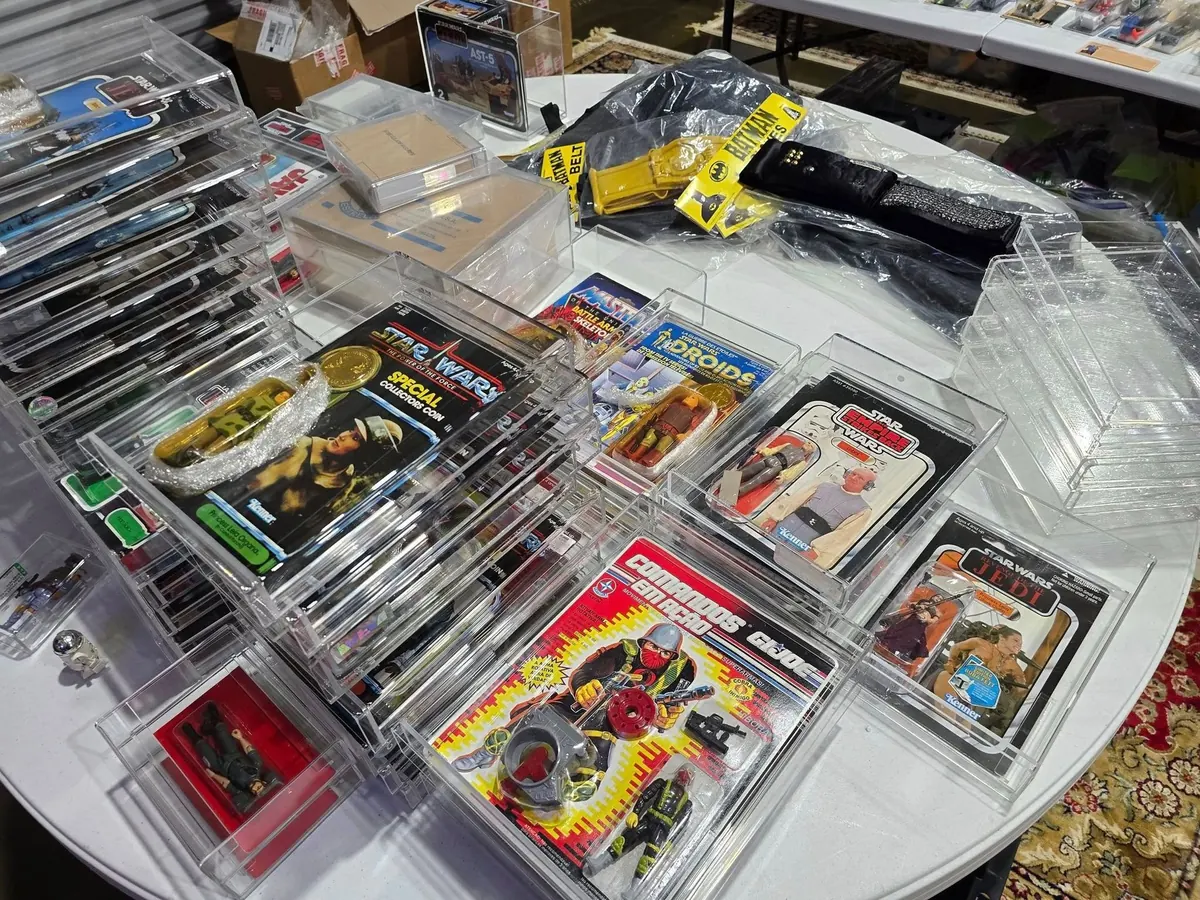
Most collections we buy come from one of three places: a collector thinning the shelf, a family clearing out a house, or someone who found their own childhood in a box in the attic. The seller's situation is different every time. The mistakes are almost always the same. Here is how to avoid them.
1. Do not clean, repair or repackage anything
This is the one that costs sellers the most. A carded figure with a dusty bubble is worth more than a carded figure someone tried to wipe down with a household cleaner. A loose figure with its original accessories is worth more than one that has been "helped" with glue. Leave everything exactly as you found it. Dust is fine. We would rather see the piece honestly.
2. Sort by line, then by condition
Before you contact anyone, make three piles for each toy line: sealed or carded, loose and complete, loose and incomplete. You do not need to know values to do this, and it changes the quality of the quote you get. A buyer who hears "about 60 G.I. Joe figures, 12 still carded" can give you a real number. A buyer who hears "a box of old toys" cannot.
3. Photograph the whole thing, then the best pieces
Two kinds of photos are useful. First, wide shots of everything laid out, so the buyer can see the size of the collection. Second, close-ups of your strongest pieces: the front and back of any carded figure, the label inside any graded case, and the accessories that came with a loose figure. Natural light near a window beats a flash. Phone photos are fine.
4. Be straight about condition
You will not get a lower offer for saying "the card has a crease" up front. You will get a lower offer, or a canceled deal, when it turns up in the photos we ask for later. Describe what you see: creases, yellowed bubbles, price stickers, broken joints, missing weapons. Every one of those has a normal place in the market.
5. Know what the buyer needs from you
When you fill out our seller form, we ask for six things, and each one has a reason:
- What you want to sell. The brands (Star Wars, TMNT, G.I. Joe, MOTU and so on), rough quantities, and whether pieces are sealed, loose or graded.
- Approximate number of items. A dozen figures and four hundred figures are different conversations.
- How many are graded. Graded pieces are quick to value because the condition question is already answered. This is the one optional question; here is what graded means if you are not sure.
- Photos. At least one, up to six. The wide shots and close-ups from step 3 above.
- Your state. It helps us estimate shipping, and if you are near Brooksville, Florida, a local pickup may be possible.
- How you heard about us. One tap. It tells us which of our channels is reaching collectors.
We typically respond within 24 to 48 hours. If it looks like a good fit, we will call you, ask for pictures, and talk through a quote.
What "top dollar" actually means
An honest buyer pays for what the pieces are, not for what a listing site says a perfect example once sold for. The number moves with the toy line, the year, the condition, and what is missing. A quote from us will tell you which pieces are carrying the value so you can decide what to do with the rest. If you want to sell a few grails and keep the childhood shelf, that is a normal conversation to have.
Ready when you are
Sort, photograph, and tell us what you have, or call 352-797-2003. Single pieces or entire collections, we are always looking.