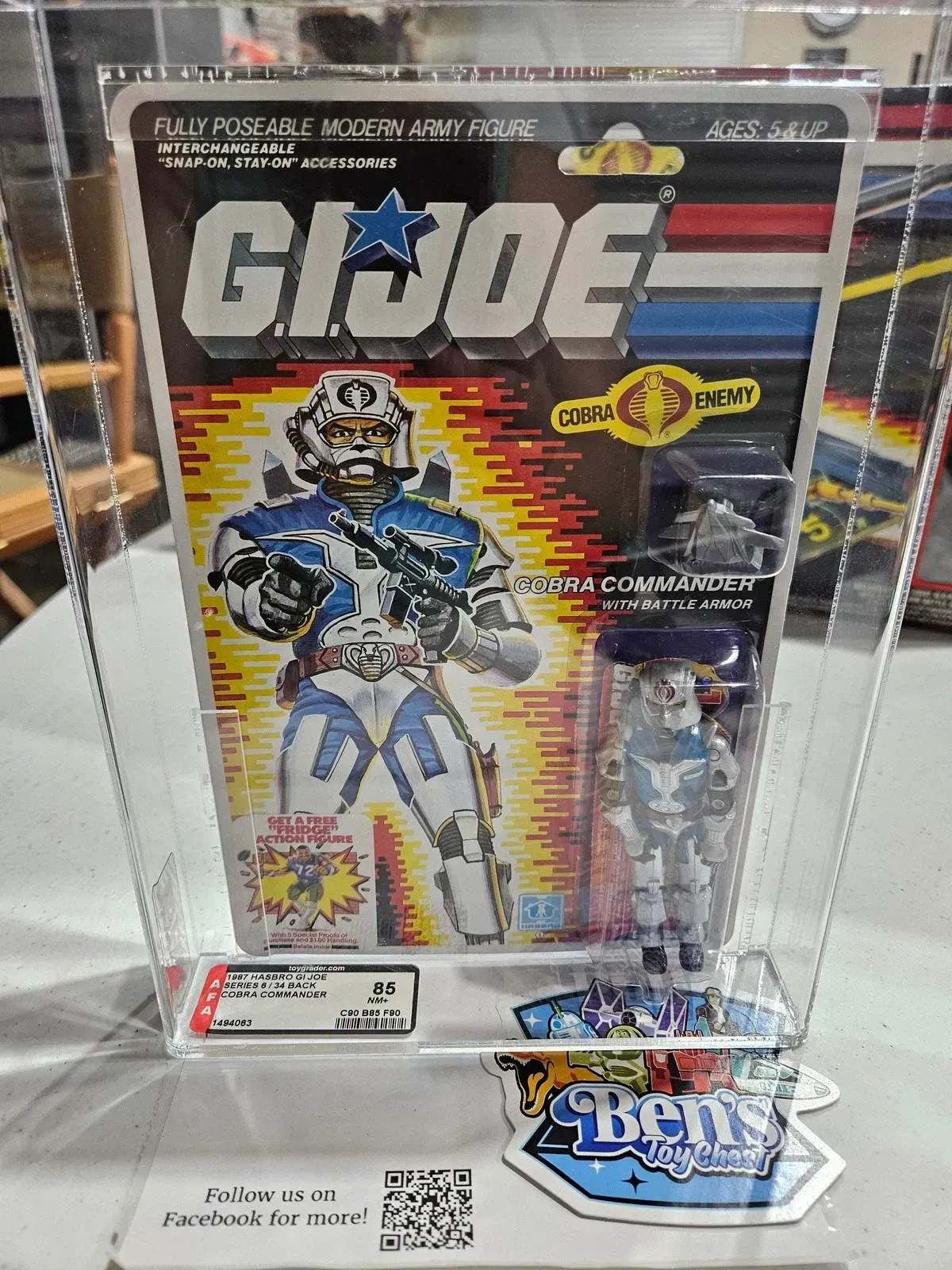
Our seller form asks one question a lot of people pause on: how many of your items are graded? If you are not sure what that means, this is the page for you. It is short, and by the end you will be able to answer it in a few seconds.
What "graded" means
A graded toy is one that has been sent to an independent grading service, examined, given a condition score, and sealed inside a hard acrylic case with a printed label. The label carries the name of the service, the toy's identity (line, year, figure) and the grade. If your figure is in a clear case with a label inside it, it is graded. If it is on its original card in a plastic bag, a display box or a comic sleeve, it is not.
The three services we see most are AFA (Action Figure Authority), CAS (Collector Archive Services) and UKG (UK Graders). We wrote a separate guide to what the numbers on those labels mean.
What happens when a toy is graded
Every service runs its own version of the same process:
- Submission. The owner fills out a submission form for the service, listing each item and choosing a service tier, then packs the pieces and ships them in.
- Authentication. The grader confirms the piece is what it claims to be: the right card for the figure, an original bubble, no resealing, no reproduction parts.
- Examination. The card or box, the bubble and the figure are each inspected and scored. Creases, edge wear, bubble yellowing, dents and paint wear all count against the score.
- Encapsulation. The piece is sealed in a tamper-evident acrylic case. Opening the case voids the grade.
- The label. A printed label inside the case shows the overall grade and, on most services, the individual sub-grades for card, bubble and figure.
- Return. The cased piece ships back to the owner. Turnaround depends on the service and the tier chosen, and can run from weeks to months.
The result is a toy whose condition has been settled by a third party, which is why graded pieces tend to change hands with less back-and-forth than raw ones.
Why it matters to a buyer like us
When you tell us how many pieces are graded, we can move faster. A graded figure comes with its condition already documented, so we can value it from the label and a photo of the case. A raw figure needs a closer look at the card, the bubble and the figure before we can say anything useful. Neither is better or worse to sell. They just take a different path to a quote.
How to answer the question on our form
- Count the pieces that are sealed inside a labeled acrylic case. That is your graded number.
- Not sure? Leave the field blank. It is the one optional question on the form, and we will sort it out when we see your photos.
- If you have graded pieces, photograph the label inside the case. It tells us most of what we need.
Should you grade before you sell?
Usually not for the sake of selling to us. Grading costs money and time, and we buy graded and ungraded pieces alike. Where grading earns its keep is on a sealed or carded figure in strong condition that you plan to hold, display or sell to a collector who wants the case. If you are on the fence about a specific piece, send us photos and ask. We will tell you honestly whether it is a candidate.