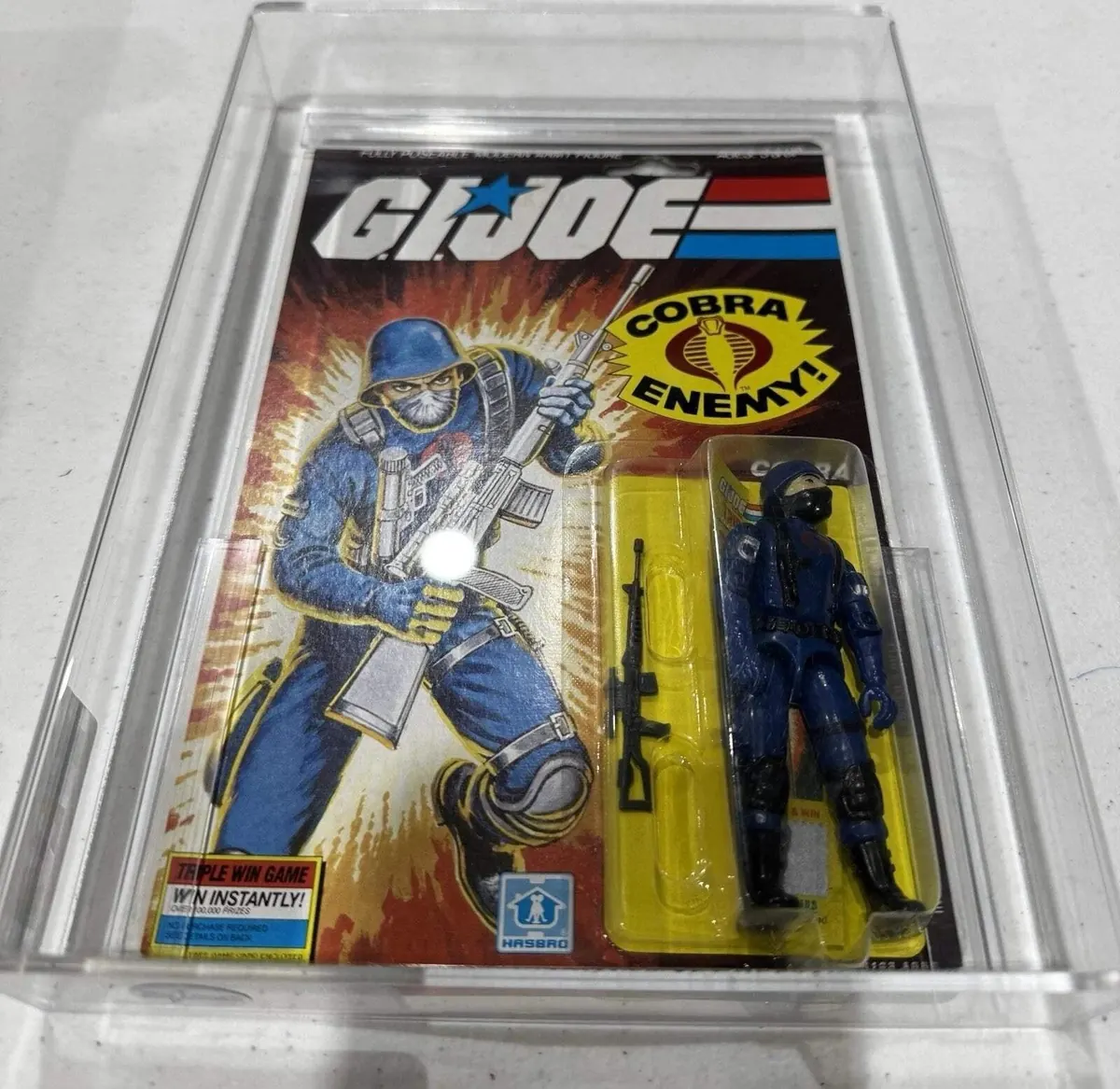
Walk through our inventory and you will see the same short labels over and over: AFA 80, CAS 85+, UKG 80%. To a new collector they look like part numbers. To a sealed-toy collector they are the whole story. Here is what those labels mean and how to read them.
Who the graders are
Three third-party services show up most often on vintage action figures:
- AFA (Action Figure Authority): the longest-running grader for carded and boxed toys, and the one most US collectors reference first.
- CAS (Collector Archive Services): a newer service with its own scale, popular for the same carded figures and vehicles.
- UKG (UK Graders): the grader most European pieces come through, which is why you see it on items like a Glasslite Star Wars TIE Interceptor. UKG reports its grade as a percentage.
Each service examines the piece, seals it in an acrylic case, and prints the grade on a label inside the case. The case is tamper-evident, so the grade travels with the toy.
What the number covers
A graded figure is scored on three things: the card (or box), the bubble (the clear blister), and the figure itself. The final grade is a single number, and the label usually lists the three sub-grades next to it. That is why two figures with the same overall grade can look different in hand: one may have a crisp card with a slightly yellowed bubble, the other a perfect bubble on a card with a soft corner.
On the AFA and CAS scales, the numbers that come up most in our inventory read roughly like this:
- 85 and above: Near Mint or better. Sharp corners, clear bubble, no visible wear from a normal viewing distance. Our 1979 Kenner Boba Fett is an AFA 85+, which AFA labels Near Mint+.
- 80: Near Mint. Excellent shelf presence with minor flaws you have to look for. The 1985 Cobra on our home page is an AFA 80.
- 70 to 75: Excellent. Clearly vintage, clearly cared for, with wear you can see.
UKG's percentages track the same idea: a UKG 80% piece sits in the same neighborhood as an AFA 80.
Why sealed collectors pay for the case
A grade does three things a loose figure in a bag cannot:
- It settles the condition argument. Buyer and seller are working from the same third-party opinion, not two sets of photos.
- It confirms the piece is original. The grader checks that the card, bubble and figure belong together and that the bubble has not been resealed.
- It protects the toy. The acrylic case keeps a forty-year-old blister from yellowing faster or getting crushed on the shelf.
None of that changes what the toy is. It changes how confidently you can buy it, which is why a graded piece and an ungraded one in similar condition rarely sell for the same money.
Reading a label in our store
When you open one of our graded listings, the title carries the grader and the grade, and the photos show the label inside the case. If the sub-grades matter to you (they do for a lot of card collectors), zoom in on the label, and if it is not legible, ask us for a close-up. We photograph every graded piece in the case it will ship in.
Thinking about grading your own?
Grading makes the most sense for carded figures that are already in strong shape and for pieces you plan to sell or hold long term. If you are sitting on a sealed collection and wondering what to do with it, tell us what you have. We buy graded and ungraded pieces, and we will give you an honest read on which ones are worth sending in.